Floyd’s Linked List Cycle Finding Algorithm#
Given a linked list where the starting point of that linked list is denoted by head, and there may or may not be a cycle present. For instance:
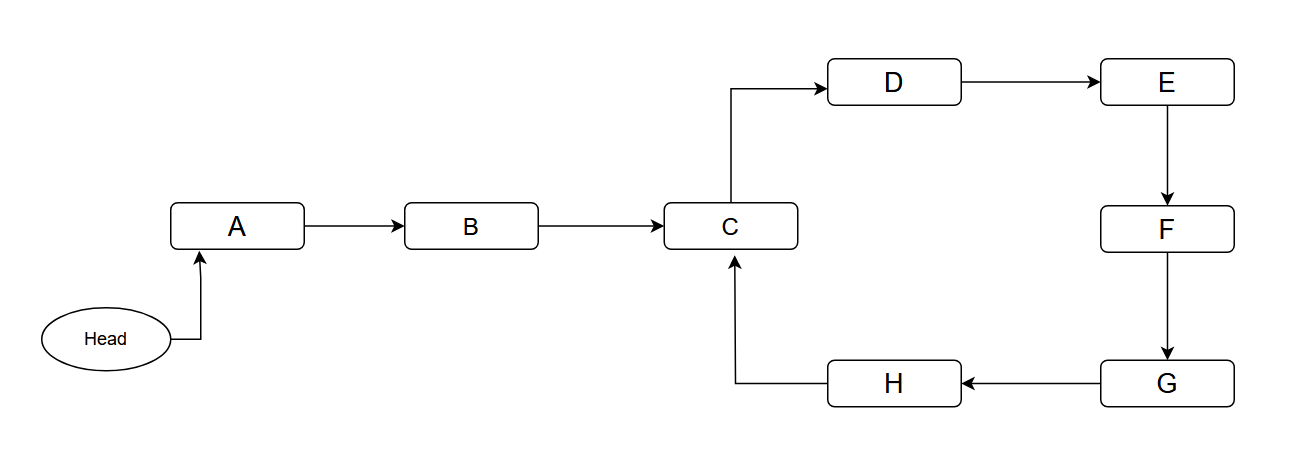
Here we need to find out the point C, i.e the starting point of the cycle.
Proposed algorithm#
The algorithm is called Floyd’s Cycle Algorithm or Tortoise And Hare algorithm. In order to figure out the starting point of the cycle, we need to figure out if a cycle even exists. This involves two steps:
- Figure out the presence of the cycle.
- Find out the starting point of the cycle.
Step 1: Presence of the cycle#
- Take two pointers $slow$ and $fast$.
- Both of them will point to head of the linked list initially.
- $slow$ will move one step at a time.
- $fast$ will move two steps at a time. (twice as speed as $slow$ pointer).
- Check if at any point they point to the same node before any one(or both) reach null.
- If they point to the same node at any point of their journey, it indicates that a cycle indeed exists in the linked list.
- If we get null, it indicates that the linked list has no cycle.
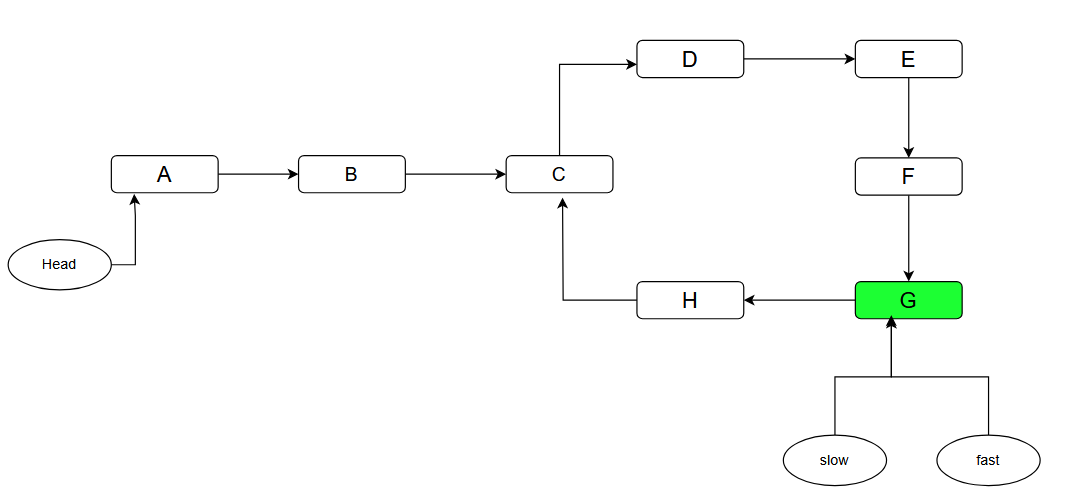
Now, that we have figured out if there is a cycle present in the linked list, for the next step we need to find out the starting point of cycle, i.e., C.
Step 2: Starting point of the cycle#
- Reset the $slow$ pointer to the head of the linked list.
- Move both pointers one step at a time.
- The point they will meet at will be the starting point of the cycle.
// Presence of cycle
public boolean hasCycle(ListNode head) {
    ListNode slow = head;
    ListNode fast = head;

    while(fast != null && fast.next != null){
        slow = slow.next;
        fast = fast.next.next;
        if(slow==fast){
            return true;
        }
    }

    return false;
}
// Assuming there is a cycle present and slow and fast are point to their meeting point
slow = head;
while(slow!=fast){
slow = slow.next;
fast = fast.next;
}
return slow; // the starting point of the cycle.Why does it work#
Step 1: Presence of the cycle#
Since the pointer $fast$ is moving with twice as speed as $slow$, we can say that at any point of time, $fast$ would have covered twice as much distance as $slow$. We can also deduce that the difference between the distance covered by both of these pointers is increasing by $1$.
slow: 0 --> 1 --> 2 --> 3 --> 4 (distance covered)
fast: 0 --> 2 --> 4 --> 6 --> 8 (distance covered)
diff: 0 --> 1 --> 2 --> 3 --> 4 (difference between distance covered by both pointers)
Let $L$ denote the length of the cycle, and $a$ represent the number of steps required for the slow pointer to reach the entry of cycle. There exists a positive integer $k$ ($k > 0$) such that $k \cdot L \geq a$. When the slow pointer has moved $k \cdot L$ steps, and the fast pointer has covered $2 \cdot k \cdot L$ steps, both pointers find themselves within the cycle. At this point, there is a separation of $k \cdot L$ between them. Given that the cycle’s length remains $L$, this signifies that they meet at the same point within the cycle, resulting in their encounter.
Step 2: Starting point of the cycle#
Lets try to calculate the distance covered by both of the pointers till they point they met within the cycle.
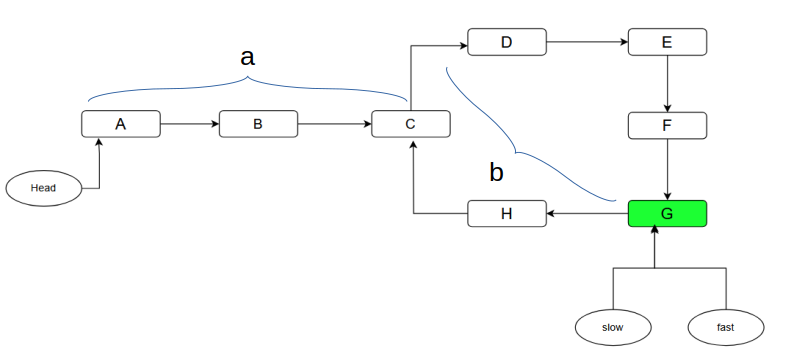
$slowDist = a + xL + b$ , $x\ge0$
$fastDist = a + yL + b$ , $y\ge0$
- $slowDist$ is the total distance covered by slow pointer.
- $fastDist$ is the total distance covered by fast pointer.
- $a$ is the number of steps both pointers need to take to enter the cycle.
- $b$ is the distance between C and G, i.e., distance between the starting point of cycle and meeting point of both pointers.
- $x$ is the number of times the slow pointer has looped inside the cycle, starting from and ending at C.
- $y$ is the number of times the fast pointer has looped inside the cycle, starting from and ending at C.
$fastDist = 2 \cdot (slowDist)$
$a + yL + b = 2(a + xL + b)$
Resolving the formula we get:
$a=(y-2x)L-b$
where $y-2x$ is an integer
This basically means that $a$ steps is same as doing some number of full loops in cycle and go $b$ steps backwards. Since the fast pointer already is $b$ steps ahead of the entry of cycle, if fast pointer moves another $a$ steps it will end up at the entry of the cycle. And since we let the slow pointer start at the start of the linked list, after $a$ steps it will also end up at the cycle entry. So, if they both move $a$ step they both will meet the entry of cycle.